
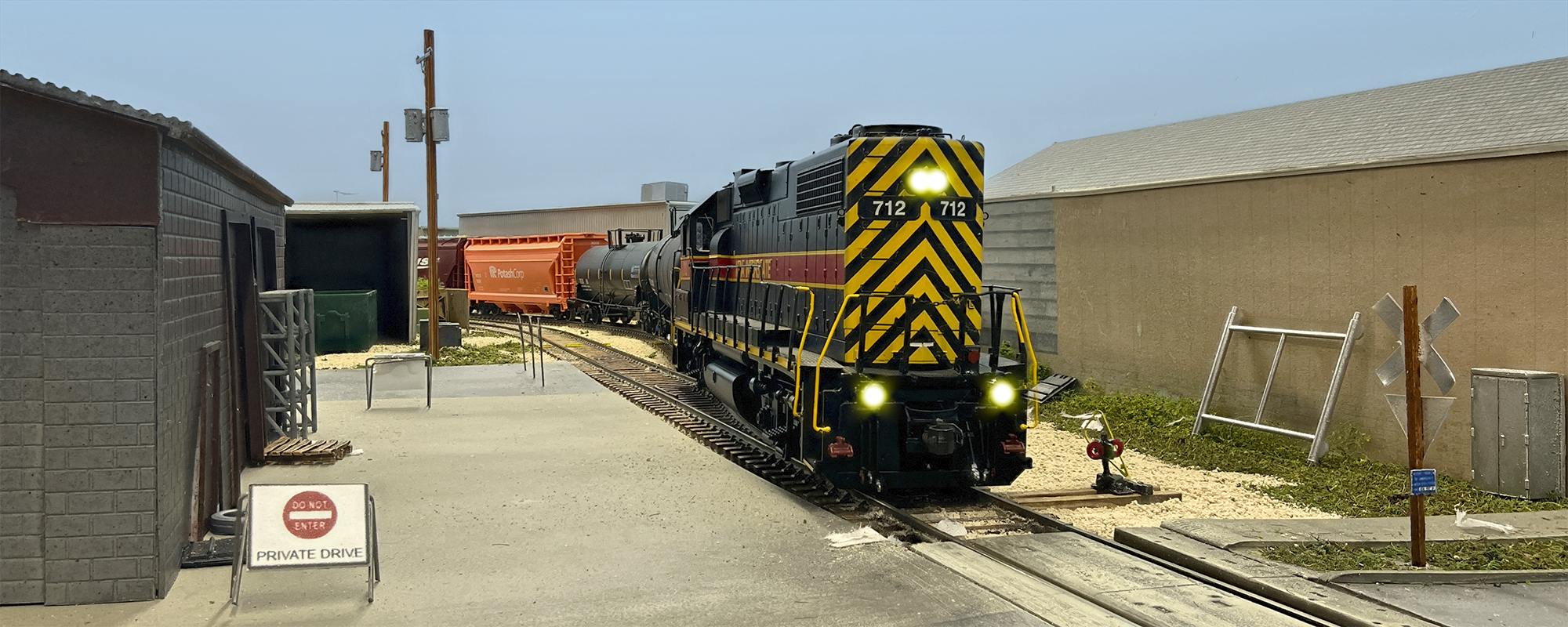

The earliest article in the hobby press I read that I can distinctly remember reading was Modeling Hansen Storage by Gordon Odegard in the March 1992 edition of Model Railroader. Looking back, I’m confident the reason I have such strong memories of the article was the fact that I thought that extending the track beyond the backdrop was cool.

For those who haven’t read or don’t remember the article, Gordon built a scaled-down version of the prototype structure for Kalmbach’s Milwaukee, Racine & Troy club layout. The key feature of the model version was that the spur tracks extended through both the building and the backdrop behind, allowing for considerably more capacity than was visible. For modeling a structure from the then-modern era, such capacity was key.
I didn’t realize it at the time, but the key takeaway for me was that it was possible to have more to your layout than was visible. Just about every operating layout runs on Allen McClelland’s principle of Beyond the Basement. That way our trains appear to arrive and depart from locations well beyond our capacity to replicate.

But McClelland’s principle can extend to non-operating elements on our layouts… or even those elements that do nothing more than fill space. On The Hills Line, there is a somewhat large shed next to the Hills Grain & Feed complex that serves as storage for a combine and other farm implements. Because of its proximity to the industrial spur I decided to include it on the layout, just to help establish era and location.
However, the space available paled in comparison to the space needed for the structure. As is typical in such situations, I converted my design into a modified backdrop flat set at an angle to the track and bisecting the backdrop. However, I still needed space for the combine, and to at least hint that this structure went beyond the basement.
Enter the Hansen Storage method.

While I didn’t cut through my backdrop, I did partially model the interior of the shed to give the illusion of something bigger than what was present. Since the combine blocks a lot of the view into the building, I was able to suffice with some photo backdrops of a shed interior, plus a few strategic styrene pieces masquerading as supports.
The result is far from what could be considered detailed. But for a structure that is not part of the operating scheme, nor contributes directly to traffic on the layout, you can’t ask for much more.
 The Hills Line
James … another very thought provoking article ! ALL structures count and can add ( especially in this case ) lots more than just a “ space taker upper “ !
I’m about ready to start on my first layout project and will absolutely put this fine lesson to work pronto !
Thank you so very much for this and all the other articles here !
LikeLiked by 1 person