


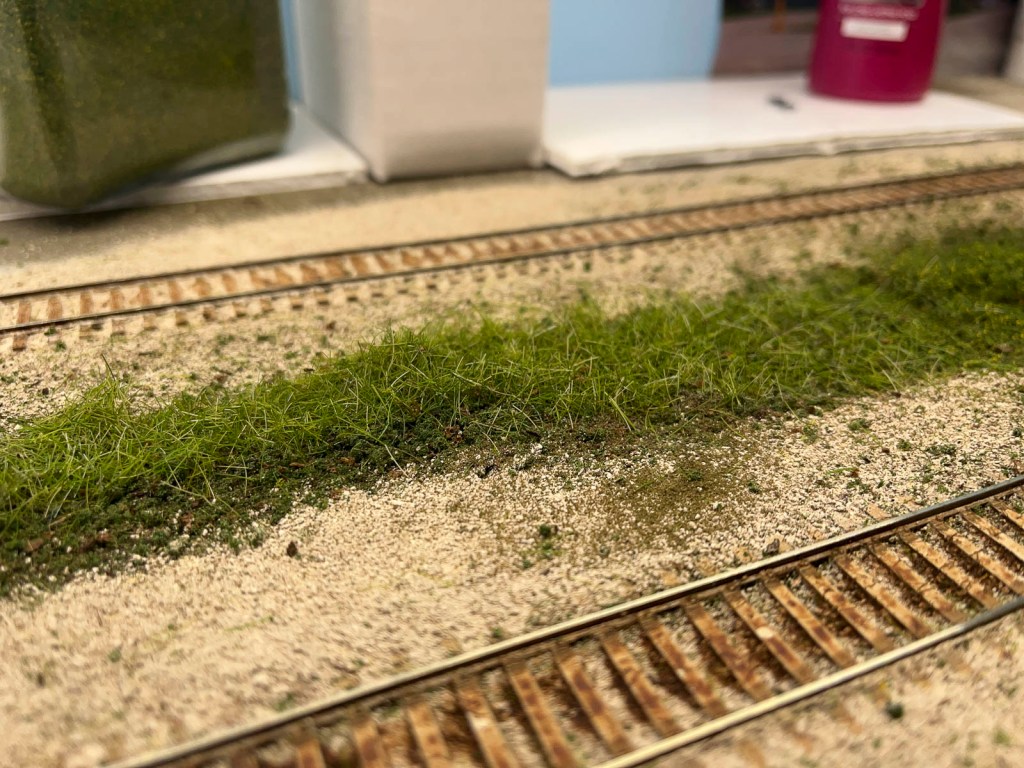
Confession time. As long as I’ve been involved in model railroading, I’ve never used static grass.
That’s not entirely true. For many years I’ve used the Farm Pasture Blend from Scenic Express as my base scenery layer, both on the IAIS Grimes Line and now on The Hills Line. To my eye, the blend does a good job of replicating the color and texture of early summer grasses that I see in Iowa.

The trade off is that it’s a blend of 2mm static grass and ground foam. When applied with a static applicator, a lot of the ground foam gets caught in the charge screen and never gets applied. When applied by hand, the static grass obviously never gets charged and lays flat. In other words, it’s not “true” static grass.

So with the scenic work on the southern end of the Eldon C. Stutsman complex, I took it as an opportunity to try new methods and materials. I picked up a variety of 7mm static grasses from Woodland Scenics and mixed them together in the applicator hopper.

With the area masked off (since static grass applicators have the accuracy of an elephant gun) I went about applying my custom blend to the scene. Conclusion… about the same as what I had already done.
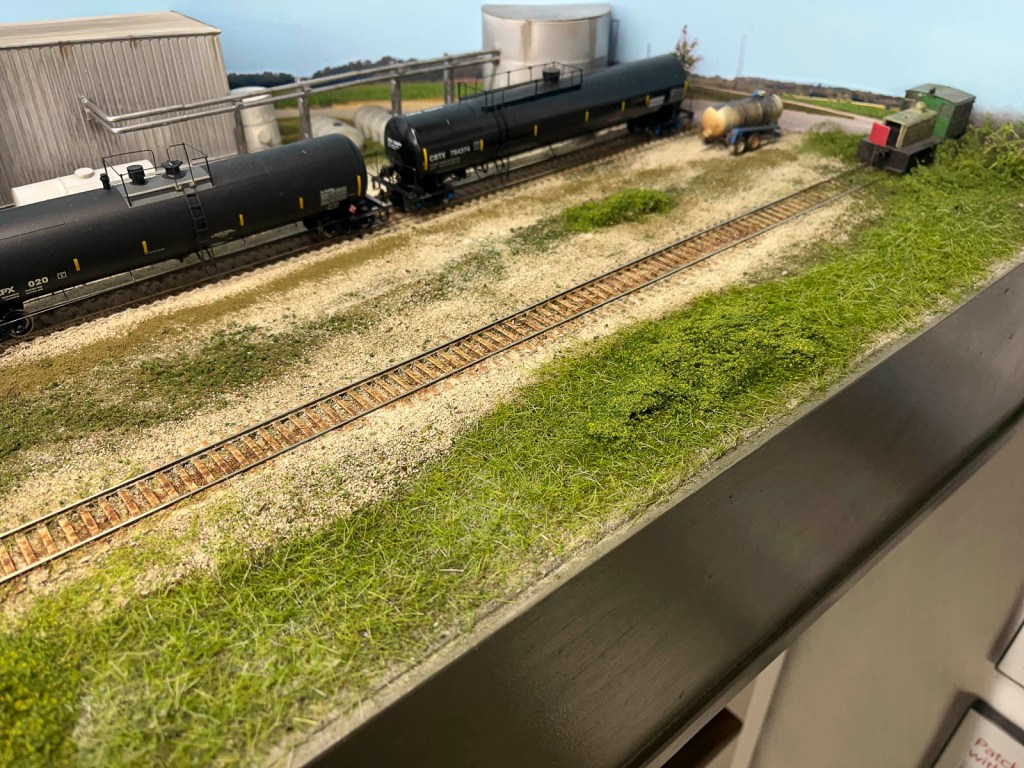
Yes the longer fibers do make for a thicker scenic base than the pasture blend. However a lot of those fibers did not stand up when applied. That was probably due to my adding it on top of an already scenicked scene. But even so, the color pallet was very monochromatic despite my intentional mix and match approach to the materials. I ended up applying several weed patches using polyfiber fill and Woodland Scenics Blended Turf, which are the same materials that I use to make weeds on the rest of the layout
There may be some areas on the layout where I will go back and apply the longer fibers to an existing scene. But overall I think I’m going to stick with the methods that I know and trust. Not that the other way is inferior or substandard.
After all, I respect the weeds.
 The Hills Line
James … well it’s many times the tried and true that gets it done !
Merry Christmas to you and family
Terry
LikeLiked by 1 person
I have never used static grass, but have been thinking about it lately. I previously purchased a bug swatter racket from Harbor Freight to make one (they did it on What’s Neat), but ended up using it on flies. Now I am thinking about one of the cheap applicators you can find on eBay, but don’t know if they work well.
LikeLiked by 1 person
James, on my first layout I put down ground foam everywhere first just to get past the plywood and pink foam stage, so all the static grass I later added was over ground foam. Given that, I don’t think that’s the source of your static grass not standing up.
I noticed in the one photo that your ground wire is leading from the applicator *away* from the layout. Whenever I had problems with grass not standing properly, I could usually trace it back to the ground. I originally read that the applicator should be grounded *outside* of the pool of diluted white glue that you’re applying into. However, later I read that it should be just the opposite. It’s been so long since I’ve done it that I don’t recall which one I landed on, so I’ll be experimenting again when I get back to the scenery stage on the new layout.
Might be something to play with if you’re still interested in going the static grass route.
LikeLiked by 1 person
Thanks Joe. This requires more practice
LikeLike
Joe. What works for me is to apply the status grass first, using a slightly thinned white glue as the adhesive, but only having enough grass blend for a small area. Then after applying the static grass over that area, go back over the area with ‘just’ the applicator in a ‘charged’ state, holding it about a half to three quarters of an inch away from what I applied. Watch it from the side so you can tell if you’re too close or not close enough. This will get the status action to get those fibers to stand up.
should see a difference in the ‘standing’ of the fibers.
move on to another section, giving the prior section time to dry. Once the prior section sets up, could be anywhere from an hour to a day depending upon your conditions, go back over the area with a hair spray, then a quick dusting of the ground foam to get some extra thickness or side growth to stick to the fibers.
nice thing about scenery work is that if it’s not how you want it, just add another layer!
LikeLike
Good tips Lee. Hitting that hairspray with another layer of grass can give some nice height variation as well.
I think it was Jason Klocke who suggested, once the grass is dry, doing hairspray and a very light dusting of ground foam to simulate some weed pods on top of the plant – kind of similar to what you’re saying. I’ve been happy with the outcome of that.
And a very good point about layering! The best incentive I’ve found to overcome a fear of scenery.
LikeLike